March 6, 2026
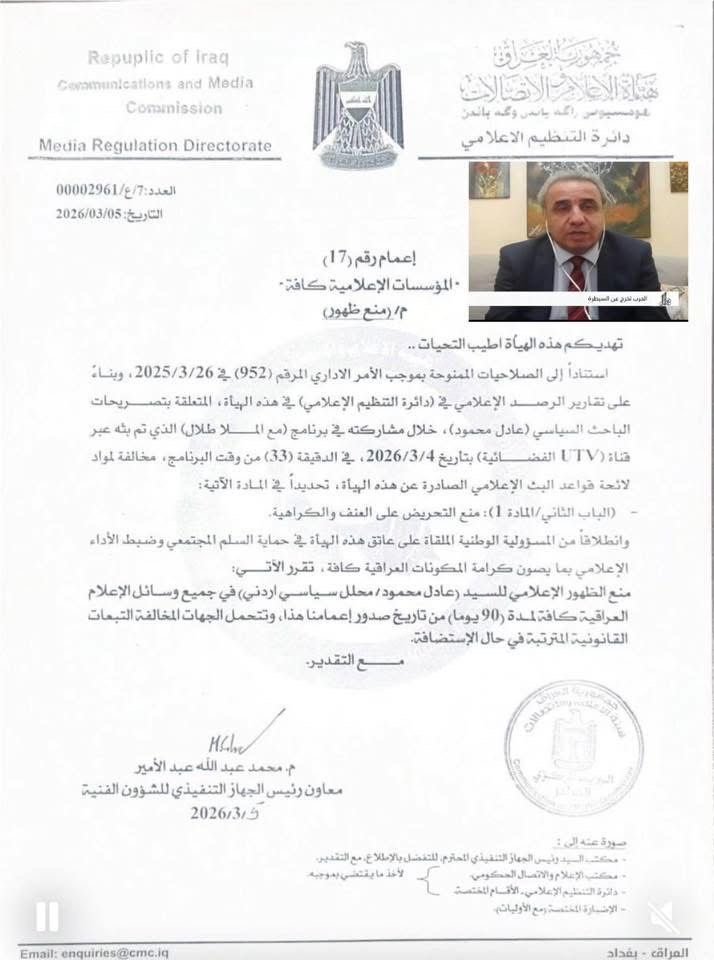
The Iraqi Communications and Media Commission (CMC) has issued a decision banning Jordanian political researcher Adel Mahmoud from appearing on Iraqi media outlets for a period of three months.
According to an official document issued by the Commission’s Media Regulation Department, the decision followed statements Mahmoud made during his appearance on the program “Ma’a Mulla Talal” broadcast on UTV satellite channel. The document stated that the researcher had violated broadcasting regulations, particularly provisions prohibiting incitement to violence and hatred.
Meanwhile, the Press Freedom Advocacy Association in Iraq stated that it is monitoring what it describes as violations committed by the Commission through actions that exceed its legal mandate. The association considers the decision part of a systematic restriction on press freedom, warning that such measures signal the Commission’s intent to interfere in Iraqi media discourse and impose political preferences on media outlets during a particularly sensitive period for the region.
The association emphasized that the ongoing conflicts and rapid developments in the region increase the need for access to information rather than restricting it. It stressed that Iraqi media outlets have the right to host diverse viewpoints, and that Iraqi audiences have the right to be informed about the perspectives and positions of different parties, in accordance with the Iraqi Constitution.
The association called on the Iraqi authorities to review the decisions of the Communications and Media Commission and reconsider its approach toward the media, warning that such practices violate the constitution and exceed the Commission’s regulatory authority. It cautioned that these actions risk transforming the Commission into a de facto Ministry of Information—an institution that the Iraqi constitution effectively abolished as part of the country’s transition from dictatorship to a pluralistic democratic system.